St. John the Baptist Excelsior – St. Therese
Deephaven Father Thomas Cushen
Knights of Columbus Council 5268 Charity, Unity, Fraternity and
Patriotism
History of K of C Council 5268
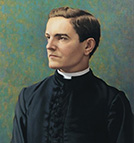
The Reverend Thomas Cushen was born near
Hamilton, Ontario, on October 27, 1877. Following ordination in
1904, he was assigned as an assistant at the Cathedral of Saint Paul
and then to a post at St Joseph’s Church.
Archbishop John
Ireland appointed Father Thomas Cushen to the Parish of Saint John
the Baptist in December 1910 in “pro tem” status due to concerns
over his health. After a little more than a year at his post, Father
Cushen took a seven-month leave of absence due to a battle with
tuberculosis, moving to a sanitarium in Walker, Minnesota.
In May 1913,
Father Cushen returned to Excelsior to take up his duties again. To
fight back against his poor health, he began to walk everywhere,
even making parish calls as far away as Tonka Bay.
By November
1914, he was able to move into a new rectory, built on a tract of
land adjoining the church and fronting on First Street. Encouraged
by his improving health and the substantial commitment of the local
parish, Father Cushen settled into a long pastorate. Many
parishioners, recalling his personality, noted both his kindness and
his gruffness. As one parishioner said, he “had a special presence
which caused you to respect him.” Another parishioner recalled
Father Cushen telling a churchgoer who couldn’t give anything to the
parish collection to put an empty envelope in the basket, and he
would be the only one who would know what she gave.
Father Cushen
quietly made a mark on the community. In 1917, he was elected
president of the Commercial Club, a position he took seriously.
In September
1925, led by Father Cushen, the parish purchased nearly seventeen
acres on the eastern shore of Christmas Lake. About nine acres of
this land was set aside and developed as the cemetery and named
Cemetery of the Resurrection. The cemetery was expanded in 1946
through the generosity of Father Cushen, who bequeathed a
substantial amount to the parish building fund.
As peace came in
1945, after two world wars and the great depression, Father Cushen
celebrated his thirty-fifth year as shepherd for the local flock. As
one parishioner said, “It was a mark of his compassionate and steady
leadership during these years that the parish continued to function
and go forward.”
As the parish
grew, parishioners pressed for an addition to the church as well as
a school for the children. Father Cushen was instrumental in
securing new property on Mill Street but insisted that the nuns
should have a proper home before the parish built a school or new
church building, as the nuns always seemed to be thought of last
when it came to housing. The new school and convent were completed
in 1952.
Father Cushen was hardly ready to rest on
his laurels. Almost as soon as the school opened, he campaigned for
a major addition with an auditorium/gymnasium, arguing that it would
be a great facility for the school kids as well as a place to hold
bingo games to help raise additional funds for the parish. Never one
to avoid his personal responsibility, Father Cushen donated an
inheritance of $30,000 to build a gym.
As Father Cushen
grew older, he took on an almost mythical quality among the
parishioners who never knew life without the presence of the tall,
Lincolnesque pastor.
In the fall of
1959, Father Cushen, in poor health, entered the hospital in
September and returned again in January 1960. In early 1960, Father
decided to take some time off and travel to Europe. In March of
1960, the parish received word from London, England that Father
Cushen had died. His body was brought home and, following a funeral
service in the auditorium, he was buried in Resurrection Cemetery.
Towards the end
of his life, Father Cushen wrote a pastoral letter for the parish
newsletter, counseling, “Although many people place an undue
importance on material things of life, we all know that the material
things cannot be taken from this world into the next. When we stand
before God, it is not our house we lived in on earth, nor the
balance in our bank accounts that we are judged. God judges us by
the state of our souls and by the record of our good works in His
service in the name of our Lord Jesus Christ.”